On February 10, 2026, the Financial Oversight and Management Board for Puerto Rico (Oversight Board) held its second annual Economic Forecast Symposium, which brought together Government representatives and economy experts to discuss data essential to developing credible, accurate economic forecasts that guide strategic budgeting and structural reforms.
“Puerto Rico cannot fix its credit without fixing confidence, and confidence starts with credible budgets built on credible economic assumptions,” said Oversight Board Executive Director Robert F. Mujica Jr. in his opening remarks.
The data revealed in this year’s symposium showed a consensus among panelists: despite their different models and vantage points, the Island is not heading into an economic downturn, but it is heading into a period of slower, more measured growth.
A national economy that bends but doesn’t break
The conversation opened with Michael Zdinak from S&P Global Market Intelligence (S&P), who explained how last year’s economic uncertainty gave way to an unexpectedly resilient U.S. economy.
“Back in April a recession looked almost imminent,” stated Zdinak, “Markets reacted badly to the announced reciprocal tariffs, and policy uncertainty spiked. But the Administration paused those tariffs and reintroduced them later. Yes, at slightly lower levels, but now markets appear to be unfazed by this.”
Markets weathered tariff announcements, policy questions, and a federal shutdown, only to reveal stronger‑than‑anticipated momentum. Even as inflation remains elevated and borrowing costs are still high, the U.S. continues to grow, and S&P’s projected scenario does not include an economic contraction.
The labor market is softer, but not weak. Job gains have slowed because businesses are holding on to the employees they have, rather than expanding aggressively. Productivity is up, population growth is down, and firms need fewer new hires than in previous years, which keeps the unemployment rate stable. It’s a very different dynamic from a classic downturn.
Against that backdrop, the national picture for 2026 looks like this: growth continues, but at a gentler pace. Inflation stays somewhat stubborn. The Federal Reserve, the Central Bank of the United States Government, stays cautious. Tariffs filter more noticeably into prices. Households might feel financial pressure, but not to the point of destabilization.
Puerto Rico Follows a Similar Path
When the conversation shifted to Puerto Rico’s economy, the same dual reality took shape: slowing momentum, but no looming collapse.
Gustavo Rojas Matute from Moody’s Analytics pointed out that Puerto Rico has been navigating a turning point, one defined by heavy reliance on federal funds, a shrinking workforce, and the gradual return to “normal” after the extraordinary federal aid that followed the COVID-19 pandemic and recent natural disasters.
Construction, transportation and warehousing, and tourism have been the key engines since 2020, and they continue to function. Tourism delivered a powerful performance in 2025, and although it may soften ahead, it remains comparatively strong.
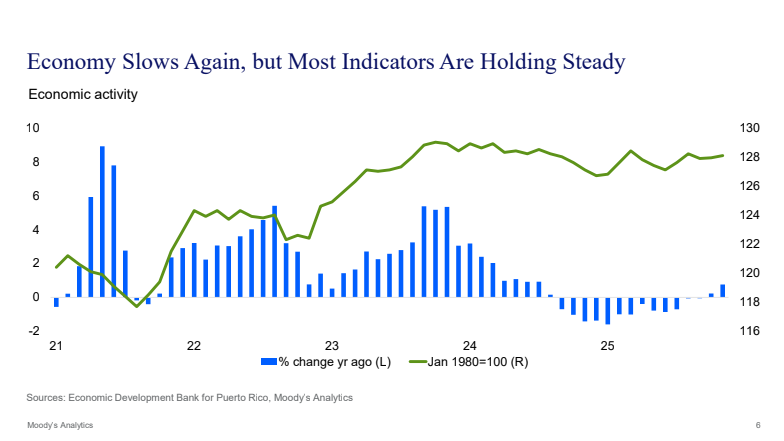
“The rest of the [economic] sectors…manufacturing, those sectors that are professional or business services, those sectors that actually concentrate the biggest share of employment in Puerto Rico, are completely flat,” explained Rojas Matute.
Puerto Rico’s economy appears to be transitioning into a slower phase of growth. The labor market landscape is complicated; unemployment is low, yet the share of part‑time jobs is rising, and younger workers face stubbornly higher unemployment rates. Consumer behavior shows similar tension; families are spending, but increasingly out of necessity rather than choice, and more often by leaning on credit. It’s not a crisis, but it is a sign that budgets are tight.
Several panelists, including Leslie Adames from Estudios Técnicos, noted that inflation in essential goods (especially food) remains far more intense than headline inflation (overall inflation) suggests. Some goods have doubled or tripled the Island’s average inflation rate. When wages flatten or slow while food prices jump into double digits, inflation becomes more persistent and difficult for households to absorb.
“We’re seeing that establishments that sell those products (essential goods), are experimenting very slow sales growth and we are seeing that there is a surprising amount of growth in some establishments that specialize in luxury products,” Adames indicated. “What this means is that people that have money and are not sensitive to changes in prices can spend more money on that type of thing. But most people, who don’t have that purchasing power, don’t have the flexibility to consume what they want.”
Still, this pressure has not translated into a contraction. The economy is not shrinking. According to the panelists, what the consumer is seeing is a slowdown, visible in lower sales growth, more cautious hiring, and businesses preparing for a steadier, more modest pace of activity.
The Role and Limits of Federal Funds
The clearest point of agreement across the panel was the continued importance of federal funds to Puerto Rico’s stability. Billions of dollars exist for reconstruction through 2035, and these funds keep the construction sector active, support job stability, and help anchor short‑term growth.
But nearly every panelist also raised the same concern: disbursement remains painfully slow, and the Island’s capacity to execute large‑scale projects is still constrained by labor shortages, rising material costs, limited contractor bandwidth, and bureaucratic obstacles.
The funding exists; the challenge is converting it into actual economic output at the pace originally hoped for.
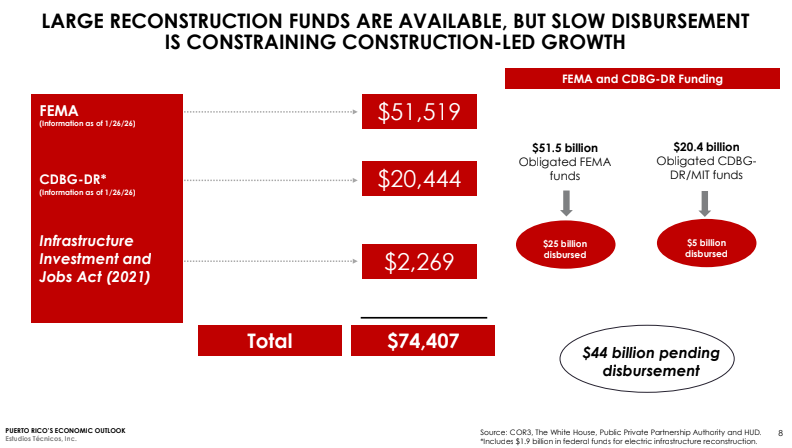
In the near term, this funding challenge represents a turning point for Puerto Rico. Federal dollars can sustain an economy through turbulence. But this funding is not a permanent substitute for a more diversified and productivity‑driven growth model.
Tourism Holds Steady, but Growth is Slowing
Across the board, tourism was described as one of Puerto Rico’s most resilient pillars. Visitor arrivals remain high, hotels and restaurants continue to hire, and the Island’s profile as a leisure destination has strengthened.
However, the consensus was cautious. U.S. households are watching their budgets more closely, and although Puerto Rico is well‑positioned, the explosive growth of the past two years is expected to slow. Tourism remains far from risk point and shows stability in the near term.
A Flat but Stable Forecast for 2026
The 2026 Economic Forecast Symposium panelists agreed: Puerto Rico is not facing a downturn. Instead, it is stepping off the unusually fast track it experienced during the years of reconstruction and pandemic‑era liquidity. The balance sheets of households and businesses are stronger than they were a decade ago, deposits remain elevated, and key sectors continue to hold.
“For a few years we have seen net immigration. That is something new for us in several decades,” said University of Puerto Rico Professor José Caraballo Cueto, “Total employment has been growing during the past few years…as well as self-employment. We are not sure why self-employment has been growing so much; it probably is related to the tax reform of 2017.”
But momentum is slowing. Outlooks from Moody’s, V2A Consulting, Estudios Técnicos, and independent economists landed in the same conclusion: 2026 will look a lot like 2025, flat or slightly positive growth, with noticeable pressure points but no recession.
“We are likely to continue seeing some economic uncertainty and geopolitical uncertainty, which is not going to be much different from what we saw in 2025 also, so not much difference in that area against last year,” concluded V2A Consulting Director Xavier Diví.
The labor market bends but doesn’t break. Tourism decreases but stays strong. Inflation cools, but not evenly. Funds continue to flow, but more slowly than ideal.
The Shared Message: Stability, with Improvements Needed
What distinguished the 2026 Economic Forecast Symposium was a notable convergence of views. Every panelist, regardless of discipline or analytical framework, ultimately returned to the same conclusion: the economy is not contracting.
This period of stabilization provides Puerto Rico with the opportunity to address several priorities. It allows the Government and private sector to advance pending projects that have faced delays. It creates space to strengthen workforce capacity and address existing shortages. It offers a window to reinforce the foundations of long‑term growth by reducing dependence on federal inflows and tourism-driven cycles. And it enables a renewed focus on improving productivity, modernizing regulatory processes, enhancing infrastructure reliability, and investing in human capital.
The outlook is not one of decline but of a slowdown that warrants close attention. This, ultimately, was the shared understanding that emerged from the Symposium, and the call to action that Puerto Rico’s leadership must now consider carefully.