Civil Service Reform Series · Compensation Pillar · June 2026
Most people accept a few basic ideas about pay: employees doing the same job should be paid on comparable terms. Pay should keep up with the job market rates, or an employer cannot attract and keep good people. And as workers build skills and take on more, their pay should be able to grow with them. These ideas are foundational in the private sector. For decades, they did not reliably hold in the Government of Puerto Rico.
Before the Civil Service Reform the Financial Oversight and Management Board for Puerto Rico and the Puerto Rico Government implemented together, the government managed compensation one agency at a time. Many salary structures dated to the 1990s. Each entity ran its own job classifications, pay scales, and salary-setting conventions, so the same job performed in two different agencies could carry materially different pay, even though Act 8-2017, the “Sole Employer Act,” was supposed to treat the central government as a single employer. Pay had also drifted well below the local labor market in many jobs, leaving the government unable to compete for the managerial, professional, and technical talent it needed to function.
Fixing this is not only a matter of fairness to employees. A government that cannot pay competitively cannot deliver services, and a pay system that no one can see or explain erodes public trust. That is why, in June 2026, the Oversight Board approved the Compensation Administration Regulation for the Government of Puerto Rico, submitted by the Office of Administration and Transformation of Human Resources (OATRH) under the Oversight Board’s authority in Section 204(b)(4) of PROMESA.
For the first time, the central government has a single, uniform, binding set of rules governing how every compensation decision is made for the roughly 23,000 career and trust employees covered under Act 8-2017.
A Reform Built One Step at a Time
The Regulation is the latest milestone in the Civil Service Reform that the Oversight Board and the Government have been building since 2021, organized around four connected pillars: organizational design, compensation, learning and development, and recruitment.
Each step was designed to lay the groundwork and produce the necessary capacity for the next. This approach was tested as part of a pilot conducted between 2021 and 2022 at the Department of Treasury (Hacienda) and the Office of Management and Budget (OMB). In January 2023, the Uniform Classification and Remuneration Plan (UCRP) delivered the first market-data-driven salary restructuring in more than 25 years. The UCRP was implemented in two phases through 2024 and increased the salaries of approximately 15,700 employees, at an estimated annual recurring cost of $151.2 million.
The scope of the reform extends beyond the agencies directly governed by the Regulation. A large share of the public workforce operates under different legal frameworks, such as public corporations, the judiciary, and other government entities that are not subject to Act 8-2017 and establish their own compensation rules. However, many have already joined the initiative: to date, 36 of these entities have implemented classification and remuneration plans approved by the Oversight Board based on the principles of the Civil Service Reform, investing more than $114 million in salary adjustments that reached nearly 15,800 additional employees. Finally, in 2024, an AI-powered, skills-based talent acquisition pilot began to expand at the government level. This pilot was recognized by the National Governors Association (NGA) as the first initiative by any state or local jurisdiction in the United States to implement the use of AI for skills-based hiring.
The UCRP built the salary structure. What it could not do by itself was govern how that structure is administered day to day — how a promotion, a transfer, or a salary increase is decided. That gap is what allowed old, fragmented practices to persist. The Compensation Administration Regulation closes it.
What the New Regulation Does
The Regulation codifies three years of implementation experience into one instrument. Its core provisions each rest on a clear design principle, outlined in the Oversight Board’s Policy Report on the Civil Service Reform.
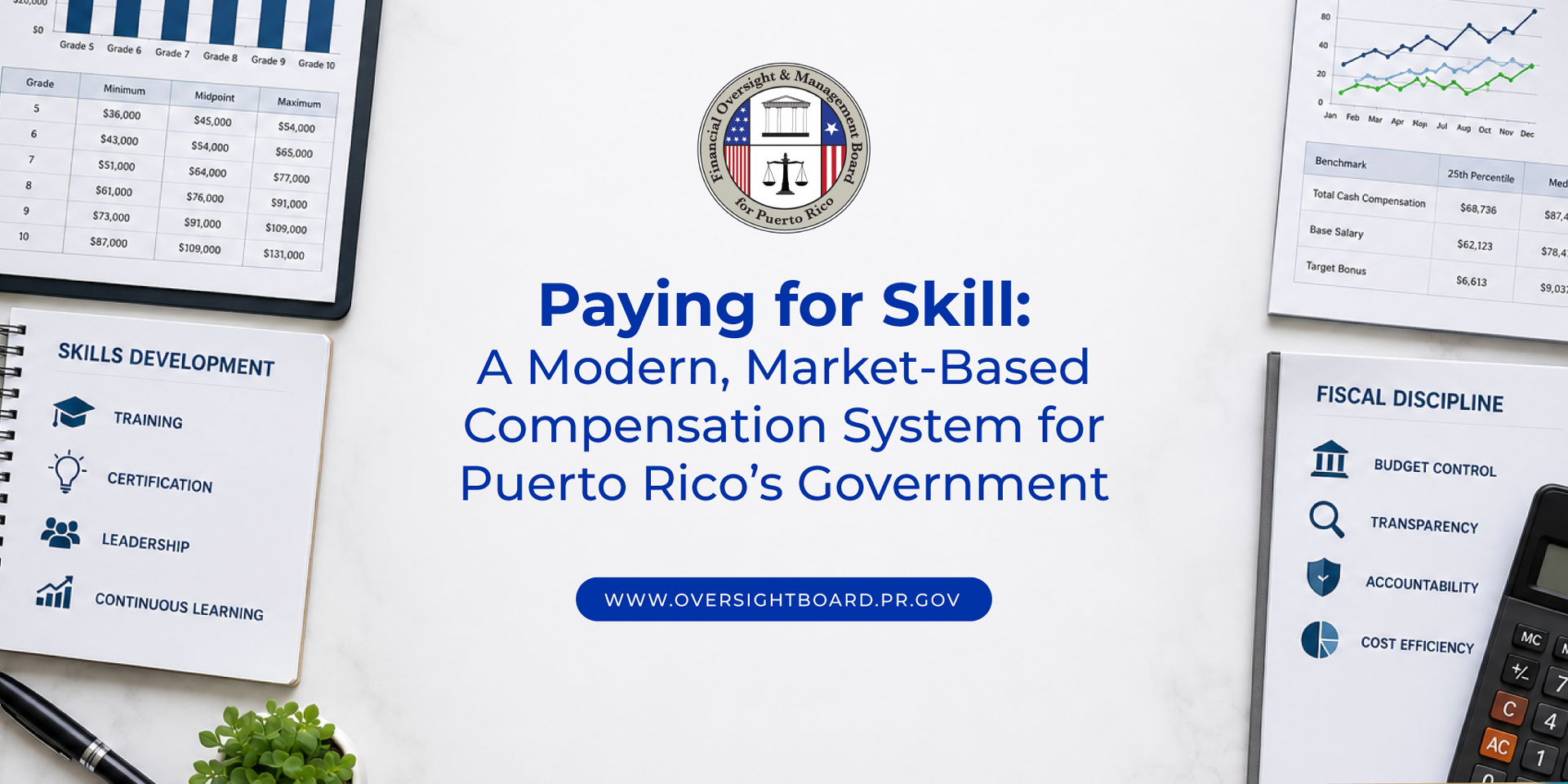
A modern salary structure anchored to the market. The Regulation establishes 25 salary grades organized into bands with three zones, below 90% of the midpoint, 90% to 110%, and above 110% up to the maximum. Each grade’s midpoint is tied to the local market median using regularly updated compensation surveys from the Economic Research Institute and the U.S. Bureau of Labor Statistics. Career movement happens grade to grade based on a position’s market value and an employee’s proficiency, rather than through automatic, longevity-based steps.
Uniform rules for every employment action. Appointments, promotions, demotions, transfers, reclassifications, reinstatements, and interim differentials are now governed by the same rules across all agencies. Identical actions are compensated identically, ending the variation that the single-employer framework was meant to prevent.
Pay that follows skill, not just time served. Salary progression is linked to documented skill development and learning hours on the government’s official learning platforms. A skill-gap diagnosis generates a personalized set of recommended courses; completing them builds verified capability that counts toward eligibility for structured increases. Learning is individualized rather than generic, diagnosed rather than assumed, and documented rather than asserted.
Fiscal discipline built into the rules. The Regulation embeds an explicit budget priority order, a convergence matrix that moves employees toward a mature market-anchored distribution over time, and a cap on non-recurring incentives, mechanisms that keep compensation decisions consistent with the Certified Fiscal Plan rather than driving unbudgeted cost.
Centralized authority to keep the system whole. The Regulation reaffirms OATRH’s exclusive statutory authority to set and revise classification and pay. No agency may alter salary structures or job classifications on its own. Without this control, uniform rules could be quietly undone, one agency decision at a time, until fragmentation returned.
For employees, a uniform framework is a protection, not a constraint. When every appointment, promotion, and pay decision follows the same published rules, the outcome no longer depends on which agency someone works in, who their supervisor is or the pressures of a given political moment. Replacing discretion with transparent, consistent rules is precisely what keeps compensation from becoming a matter of favors or rewards; it is the safeguard that protects the workforce from the arbitrary and politicized practices that defined the past.
Those failed most by the old system were often the employees who had given the government years of service while their pay stagnated, frozen to structures set decades ago and well below the local market. The framework now in place is built to address exactly that kind of inequity, to ensure pay reflects the responsibilities of a job and the realities of the market, applied consistently across agencies. It was not assembled overnight or in the abstract: it reflects three years of operational experience, and it is set and administered by OATRH, a Government of Puerto Rico institution, under the authority established by Act 8-2017.
Where Puerto Rico Now Stands
These features place the central government alongside, and in several respects, ahead of the most advanced civil service compensation systems in the United States. The federal General Schedule, created in 1949 and still governing roughly 70% of federal civilian employees, remains built on time-in-grade steps with no link to skills. Most state systems descend from that same mid-century model. No U.S. state has integrated skills-based salary progression, AI-assisted talent acquisition, and a binding fiscal-compliance framework into a single normative instrument. Puerto Rico’s reform, and this Regulation as its compensation pillar, represents a genuine departure.
What Comes Next
A regulation on paper is only as durable as its execution. Several things are now underway.
The Government will need to manage a Civil Service Budget under the new framework. This will allow for compensation decisions to be planned and funded through these uniform rules from the start of a fiscal year rather than corrected after the fact.
The principles in the Regulation also point beyond the agencies it directly covers. A large share of the public workforce operates under different statutory frameworks. Public corporations, municipalities, the judiciary, the Legislative Assembly, and the Department of Education, among other entities, do not directly operate under Act 8-2017. Although these entities set their own compensation rules, the Regulation’s principles, aligning pay with the local market, prioritizing structural adjustments, linking progression to skills, and promoting consistency, will offer a foundation for extending coherent compensation governance gradually across the broader government.
A modern salary structure can still drift from the market if updates are deferred; a uniform framework can fragment if discretion is exercised outside its terms; a skills-based system can collapse back into longevity-based practice if the supporting infrastructure is allowed to weaken. What the Regulation provides is the architecture within which sustainability is possible. Sustaining it is the shared work of OATRH, agency human resources teams, the Governor’s Office, the OMB that allocates funds to the Civil Service Budget each year, and the employees the system is built to serve.
To read the full policy report, see Civil Service Reform: Completing the Compensation Architecture of the Government of Puerto Rico (June 2026). Learn more about the Civil Service Reform.