How much money should the government really spend? It depends how much it takes in.
Just like businesses who must project how many products they can sell each year, how many customers might walk in the door, or how many clients demand services, a government must project how many taxpayers will file their returns and how much income they will declare, how much sales taxes it will collect and how the economy might grow, how many new businesses apply for permits, and how much funding will the federal government provide.
How do governments know all this? It’s a process. Any government must forecast what it can reasonably expect to collect for the following fiscal year so it can plan and efficiently decide how much it can spend. Research, data, and experience are at the center of any sound budget.
This process is defined by several critical principles of revenue forecasting. First, the government must have good and dependable accounting systems for tracking revenue collections data. It must know exactly how much revenue was collected in the previous year and it must create a dedicated group in the budget office to analyze such data, assess the accuracy of the most recent forecast, and draw conclusions.
Expert input is critical: many states built their revenue outlook around the views of experts who inform the government how they foresee the economy performing and how much tax revenue will be generated. This consensus benefits from including the legislature in the process, and giving the public access to the deliberations and the data that go into the estimates.
The government must consider the risks to its revenue forecast, including economic stress, federal spending cuts, and others. The forecast must also be linked to decision-making and serve as a key factor in the planning and budgeting process.
Reforming the revenue forecasting process based on these best practices is a critical element of the transformation that the Puerto Rico Government and the Financial Oversight and Management Board for Puerto Rico (Oversight Board) have begun this year.
The Oversight Board organized economic forecast symposiums in 2025 and 2026, where economists from Puerto Rico and elsewhere shared their outlook. In coming years, this symposium is expected to also include participants’ outlooks on government revenue. The government is working on putting in place a system that will improve efficiency and data accuracy.
During the Oversight Board’s next symposium, A Better Plan: Symposium on Puerto Rico’s Fiscal Future – Budget Tools, Principles, and State Practices on April 15 in San Juan, budget directors from six U.S. states will discuss the critical elements of revenue forecasting, among other building blocks of an effective and responsible budgeting process.
Why is this so important for Puerto Rico?
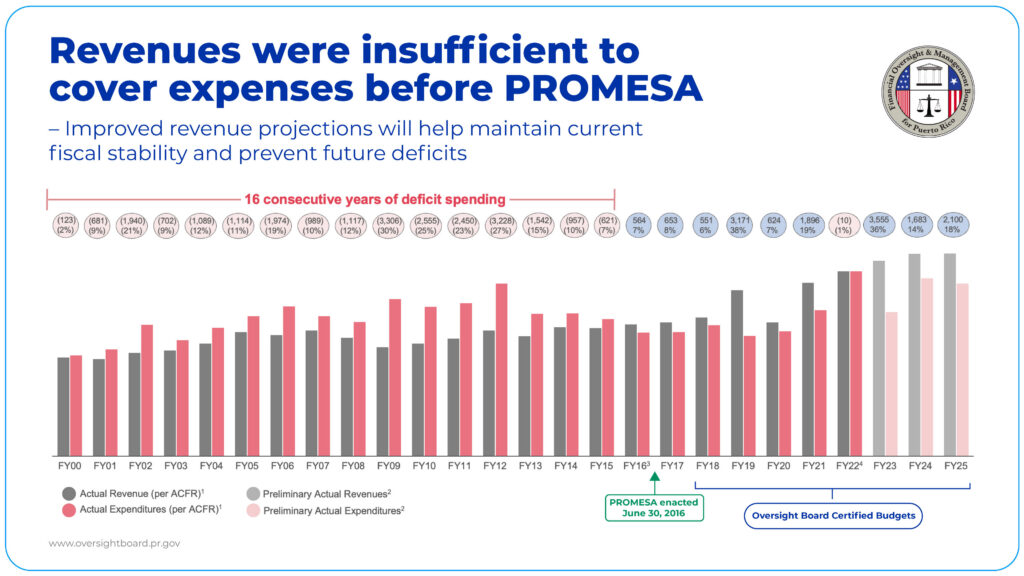
Because for almost two decades, consecutive Puerto Rico governments overestimated the revenue it would collect and therefore spent more than the appropriated amounts for a given fiscal year. That led to at least 16 years of budget deficits, and, in the end, contributed significantly to Puerto Rico’s bankruptcy. The Government and the Oversight Board have been working together to correct that.
Authority (AAFAF), and the Puerto Rico Planning Board (PRPB). This results in a series of challenges, including:
- PRPB’s economic data is incorporated into the government’s forecast. However, the timing of the full forecast has not always been consistent, and in some instances, it was not available.
- Revenue projections are generally prepared on a one- to two-year horizon; as a result, longer-term planning relies on separate macroeconomic assumptions that are not always developed within a unified framework.
- Economic data is not always produced in alignment with budget cycles, creating coordination challenges.
- Some government agencies lack staff and capacity, affecting budget monitoring, management, and budget adjustment through the fiscal year.
These challenges contributed to Puerto Rico’s budget deficits, which the Oversight Board began correcting, starting with the first budget it certified for fiscal year 2017.
Revenue Forecasting: Why It Matters
Today, Puerto Rico is shifting toward a much stronger forecasting system, one based on consensus, openness, and collaboration. Since the Oversight Board began its work under PROMESA, the government’s budget deficit has been zero. But significant work remains to strengthen adequate budgetary and other controls for effective financial management and oversight and ensure Puerto Rico doesn’t fall back into the old practices and deficits once the Oversight Board leaves.
What Better Estimates Looks Like
The Government of Puerto Rico must improve their economic and revenue forecasting processes by incorporating recognized best practices and strengthening confidence among stakeholders, including the public, private sector, and investors. Some of those standard best practices include:
1. Non-partisan approach
A forecasting committee should include experts from government, academia, and the private sector, ensuring decisions are based on data, not political pressures. For instance, following the Detroit fiscal crisis, the state of Michigan required the city to form a conference of experts that included Detroit’s chief financial officer, the state treasurer, and a person affiliated with a state university or another public entity with experience in economic forecasting and revenue projection. This conference is legally required by state law to meet twice a year and establish a consensus multi-year economic and revenue forecast.
2. Collaborative forecasting
Developing a more integrated set of economic and revenue projections can help improve consistency across short- and long-term planning. Over half of all U.S. states have a consensus approach that include both the legislature and executive.
3. Robust transparency
Public meetings and methodologies posted online help strengthen understanding and credibility by providing visibility into how forecasts were developed. A total of 47 states across the U.S. have statutory requirements to publicly publish all revenue estimates and economic forecasts.
4. Long-term orientation
Forecasts should cover at least five years to avoid short-term decision-making that puts future stability at risk. According to the National Association of State Budget Officers (NASBO), states across the U.S. typically forecast their revenues for the subsequent 4-5 years.
5. Periodic updates
Regularly reviewing and updating projections help ensure forecasts remain aligned with evolving economic conditions. Most commonly, states release official revenue forecasts two or three times each year, in addition to closely tracking actual revenue collections throughout the year, typically on a monthly basis.
How to Build a Stronger Forecasting System
The government can strengthen its forecasting capability by bringing together expertise from Hacienda, OMB, PRPB, the University of Puerto Rico (UPR), the Puerto Rico Department of Labor and Human Resources, and other entities to:
- Develop revenue models based on widely used macroeconomic inputs.
- Enhance projections for General Fund cash flows.
- Expand analytical tools to evaluate different tax policy scenarios and consider if current laws or expected changes in law that affect forecasts.
- Continue developing expenditure forecasting, particularly in areas with higher fiscal impact, such as healthcare and pensions.
This kind of integrated approach would not only reduce major forecasting variations, it would also create the foundation needed for a modern, resilient budget process.
Preparing for the Road Ahead
During the 2026 Economic Forecast Symposium, Oversight Board Executive Director Robert F. Mujica, Jr. said: “If we want responsible budgets, we start with an honest transparent view of the economy.”
Reliable economic and revenue forecasting isn’t just a technical exercise. It’s a critical ingredient for restoring trust, ensuring good governance, and building a stronger future. Puerto Rico is now moving in that direction. After years of financial instability, adopting best‑practice forecasting methods is one of the most impactful steps the government can take to maintain fiscal discipline and keep delivering essential services to the communities.
Image Sources: Audited amounts from the Basic Financial Statements, Hacienda monthly “General Fund Net Revenues” report, AAFAF 2(A) (1-4) monthly report
- FY2000 – FY2022 revenues and expenditures per the ACFR. Additionally, GF revenue excludes financing sources.
- FY2023 – FY2025 revenues are from the Hacienda’s monthly “General Fund Net Revenues” report, and expenditures are sourced from the AAFAF 2(A) (1-4) monthly reports
- FY2016 actual expenditures did not include the full debt service payment.
- FY2022 actuals do not include usage of accumulated prior year surpluses to pay for creditor settlements resulting from the Plan of Adjustment (POA).