
Consider what a career in the Puerto Rico Police (PRP) was worth on paper until this summer. The minimum salary for a police officer, the officer on patrol, was $26,400 a year1. The minimum for a colonel, at the top of the rank system, was $38,916. A full career climbing nine ranks, with each step bringing more responsibility, more people to lead, and more risk to manage, added barely $12,500 to the floor of the pay scale. The salary structure behind those numbers had not been rebuilt in more than two decades. Incumbent officers received periodic increases along the way, but the pay scale itself no longer reflected the nature of the work, prevailing market conditions, or the value of career advancement.
Two decisions made by the Financial Oversight and Management Board for Puerto Rico (Oversight Board) in 2026 changed that.
On July 9, 2026, the Oversight Board approved a new, market-based salary structure for members of PRP’s rank system, effective at the start of fiscal year 2027. On October 8, it approved the Salary Administration Guidelines for Members of the Puerto Rico Police Bureau Rank System, which PRP adopted the following day as General Order 214. The guidelines are the rules that govern how that structure is administered from day to day.
Together, they make PRP the first public entity in Puerto Rico to have all three components of a modern compensation system approved and working as one: a salary structure built from market data, binding rules to administer it, and an implementation planned and funded, from the start through the certified budget. The guidelines are the first compensation regulation the Oversight Board has approved for a rank system in Puerto Rico.
An example of the Civil Service Reform within unique workforces
PRP’s rank system is not part of the Uniform Classification and Remuneration Plan that governs Central Government employees under Act 8-2017. It has its own personnel framework, its own chain of command, and operational requirements that no general civil service structure was designed around. PRP was not required to adopt the principles of the Civil Service Reform (CSR).
It did so anyway.
The structure and the guidelines apply the same core ideas that underpin the CSR elsewhere in Government: pay that is anchored to the labor market, progression tied to developed skill rather than time served, uniform rules for every compensation action, and fiscal discipline written into the rules themselves. They do so while preserving what is specific to police service; that matters beyond the PRP.
When the Oversight Board described the CSR’s compensation architecture earlier this year, it noted that a large share of the public workforce operates under its own legal frameworks, and that the CSR’s principles could offer a foundation for coherent compensation across the broader Government.
PRP’s experience represents an important milestone in the implementation of CSR, standing as the clearest example of how its core principles can be successfully applied to one of the most operationally distinct workforces in Government. Its experience demonstrates that CSR is not a one-size-fits-all approach, but rather a flexible framework capable of accommodating the diverse operational needs of government agencies without compromising its underlying principles.
A Pay Structure Anchored to the Market
The salary structure starts from a simple question: what does the labor market pay a police officer? To answer it, PRP used the same two national salary surveys, one from the U.S. Bureau of Labor Statistics and the other from the Economic Research Institute, that underpin the CSR elsewhere in government and adjusted that median pay for police officers to Puerto Rico’s labor market. That adjusted median, $54,192.60, became the midpoint of the police officer band. The adjustment reflects the cost of labor, and what employers here must pay to attract and keep people in the occupation, rather than the cost of living, which local wages already absorb.
From the police officer midpoint, the structure builds upward. Midpoints rise 10% from rank to rank, and 12.5% from commander upward, reflecting the broader responsibility of the senior ranks. Each rank receives a band around its midpoint, with wider ranges at the top. The result restores what the old scale had lost: a meaningful step in pay at each step in rank.
Annual minimum salary by rank, previous and new structure
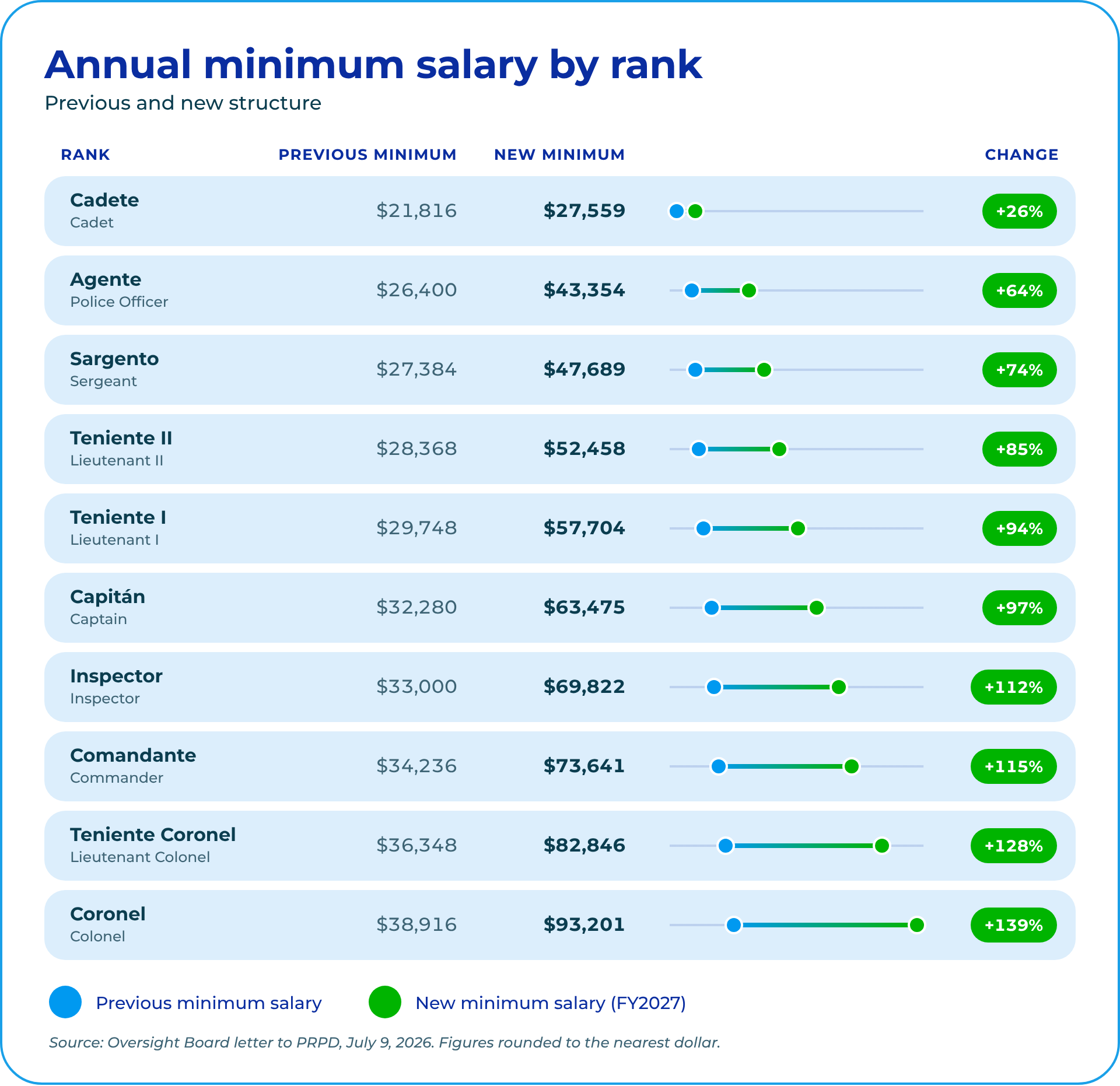
The new structure is not an across-the-board raise. Each officer’s current salary was compared with the new minimum for their rank. Officers below the new floor are brought up to it; officers already above it see no change from the structure itself. Of 11,016 active ranked officers, 5,317, or 48%, received an adjustment, averaging $5,603 a year. The annual cost is approximately $33.4 million, including fringe benefits.
Rules That Keep the Pay Structure Whole
A salary structure on its own is a snapshot. Without rules for how officers move through it, discretion fills the gap, and the old patterns return one decision at a time. That is why the Oversight Board conditioned its July approval of the structure on PRP’s commitment to adopt the salary administration guidelines reviewed and approved by the Oversight Board. The October approval completes that sequence.
The guidelines establish a uniform framework for compensation and salary progression across the rank system, including standardized rules for promotions, demotions, reentry, reinstatement, and differential compensation (when a person is paid an amount in addition to their salary for tasks they are performing that go beyond their job classification). Identical actions are compensated identically, regardless of unit, region or who is in command.
Promotions show how this works in practice. Access to the ranks from sergeant through captain still runs through promotion exams, and to the senior ranks through PRP’s promotion protocol for inspector to colonel. What the guidelines settle is how pay follows. An officer who has progressed within the band carries that progress into the new rank, receiving the full difference between the two ranks’ minimum salaries on top of current base pay: a police officer earning $45,000 who is promoted to sergeant moves to about $49,335. Promotion always pays, and no one gives up ground earned in the previous rank. Only base salary counts in that calculation; differential pay and incentives do not.
At their center is a horizontal movement matrix, used to map and track employee transfers across different departments, roles, or geographic locations at the same hierarchical or pay level, that governs salary increases within each rank. An officer’s place in the band is measured by a comparative-ratio: salary divided by the band’s midpoint, which is close to the market median for the rank. Officers below 90% of the midpoint, between 90% and 110%, and above 110% fall into three zones, and lower zones receive higher percentage increases, so officers move in an orderly way toward the market rate for their rank. Officers already above the band’s maximum receive no increase to base salary and may be considered only for a non-recurring incentive, which keeps the structure from drifting upward permanently. During each annual budget cycle, PRP will establish the salary increase percentages applicable to each zone, subject to available funding and the provisions of the guidelines. However, the order of priority is binding: zone 1 must always receive a higher percentage increase than zone 2, and zone 2 must receive a higher percentage increase than zone 3. The same percentage applies to all eligible officers within the same zone. The guidelines state plainly that neither placement in a zone nor years of service, by themselves, create a right to an increase.
Eligibility for salary increases is conditional on maintaining up-to-date skills required for police service. To be considered in a cycle, an officer must complete 40 certified hours of continuing education, annual firearms training, and biennial ethics training, hold a satisfactory performance evaluation, be in active armed status, and meet the requirements of the rank’s duties manual. This is the CSR’s central idea applied to policing: pay progression follows the continued development and maintenance of capability, not the simple passage of time.
The guidelines also bring fiscal discipline to differential pay. They are defined as temporary compensation for specific, extraordinary circumstances, such as providing service in Vieques and Culebra, field training, instruction, and crisis negotiation duties, air operations, extreme-risk assignments, and non-permanent extraordinary conditions, rather than a parallel pay scale. The larger differentials require a documented request, prior approval from the Office of Management and Budget (OMB), and an analysis that benchmarks the function against comparable Central Government job classes. Salary plus differential pay cannot exceed comparable compensation.
Officers receiving differential pay must also keep earning their place. Supervisors must certify at least once a year that the officer still performs the functions or meets the conditions that justified the differential pay, and when those circumstances end, so does the payment. Ending differential pay this way is not a disciplinary action and does not impact the officer’s base salary.
Honoring Service and Valor
Taking tenure out of the base pay does not mean ignoring service. The guidelines recognize it in a different way. At each five-year service milestone, from five to 25 years, an eligible officer may receive a one-time payment of up to 10% of the monthly midpoint salary for their rank, together with a service badge. The recognition is designed to honor continuity without altering the salary structure or the officer’s place in the band. Acts of valor are recognized the same way, with one-time incentives of $500, $1,000, and $1,500 tied to the Silver Medal of Valor, the Gold Medal of Valor, and the Medal of Valor for Heroic Acts. Because both are non-recurring, they honor commitment and courage without building permanent costs into the salary base, and they never compete with the structure itself for funding.
For officers, uniform and published rules are a protection. When every promotion and pay decision follows the same framework, the outcome does not depend on personal relationships or the pressures of a particular moment. Transparent rules are what keep compensation from becoming a matter of favor.
Planned and Funded from the Start
Too often, public pay commitments in Puerto Rico have been made first and funded later, if at all. What sets the PRP process apart is that budget planning was built into every step. The cost of the new structure was estimated officer by officer from the active roster and anchored in a payroll milestone in the Certified Fiscal Year 2027 Budget before implementation, with PRP, in coordination with OMB, being responsible for covering future-year costs with recurring resources.
The guidelines carry that discipline forward by writing an explicit priority order for salary administration resources into the regulation itself. First comes the periodic review and update of the salary structure every three to five years, so it stays aligned with the market and never again goes two decades without renewal. Each review benchmarks the market using the police officer rank as the reference and requires the applicable approvals; a review does not imply an automatic increase. Then comes the within-rank increases through the horizontal movement matrix. Finally, the non-recurring incentives for longevity and valor are reviewed. PRP must coordinate with OMB to identify the resources for each, and every salary action remains subject to available funding, the required approvals, and consistency with the Certified Fiscal Plan and Budget.
Each cycle must also be planned in advance. Once the available budget has been identified in coordination with OMB, PRP must specify the eligible officers, each eligible officer’s position within the applicable salary range, the percentage to apply, and the aggregate fiscal impact. No movement is implemented until funds have been identified, authorized, and allocated, and nothing in the guidelines creates a vested right to an increase.
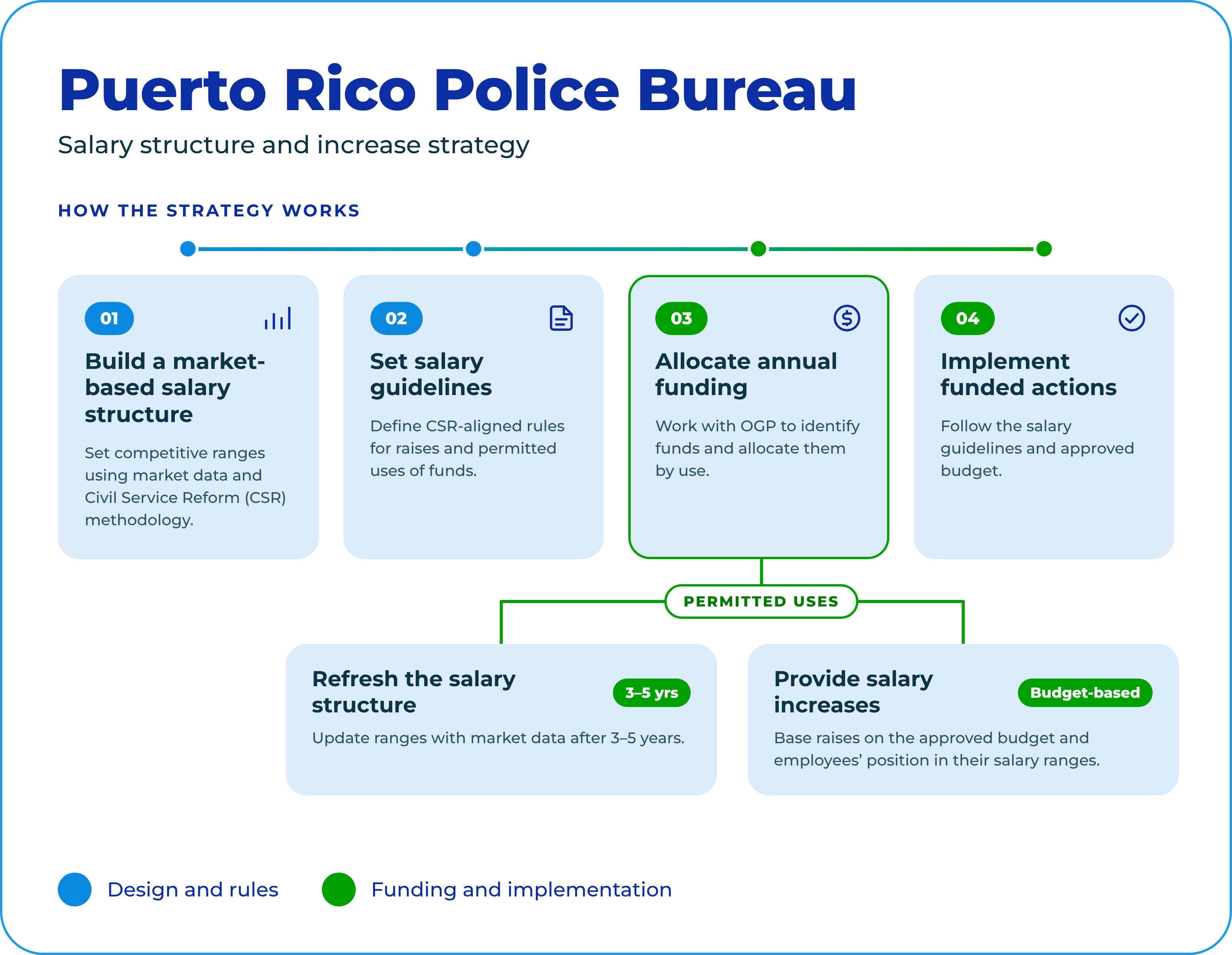
This sequencing matters as much as any single number. Market-based pay is only sustainable if the structure is refreshed on schedule and increases are granted within budgets that are known in advance. The guidelines make that the default rather than the exception.
What Comes Next
The work continues on two fronts. As a condition of the October approval, PRP must submit, through OMB and within 90 days, a classification and remuneration plan for the trust positions associated with the rank system, along with its compensation structure and supporting fiscal analysis. Bringing those positions into alignment closes the remaining gap between the rank system’s career framework and the positions around it.
The second front is execution. A structure can fall behind the market if its updates are deferred, and uniform rules can erode if decisions are made inconsistently or without adhering to established guidelines. Sustaining what has been built is the shared work of PRP’s leadership and human resources teams, the OMB, and the officers the system is designed to serve.
PRP’s experience also offers a model for others. Many public entities in Puerto Rico, including other uniformed and rank-based services, set their own compensation rules outside of Act 8-2017. The Police have now shown that a market-anchored structure, uniform administration rules, and budget-anchored implementation can be adapted to a highly specialized workforce and approved as a complete system. That is a template others can follow.
Learn more about the Civil Service Reform.
1 Act No. 227-2004 established a base salary of $2,200 per month ($26,400 annually) for the rank of Police Officer. Subsequently, the Oversight Board authorized a 30% salary increase, implemented in two 15% phases during fiscal years 2020 and 2021. Although these increases raised officers' actual compensation, they did not constitute a comprehensive revision or formal modification of the previous salary structure. Accordingly, before the implementation of the new salary structure in July 2026, the effective starting salary for a police officer was $2,860 per month ($34,320 annually), while the minimum established in the previous salary structure remained $2,200 per month ($26,400 annually).