Puerto Rico’s economic outlook is not defined by a single trend; it is shaped by a series of competing forces: strong private investment alongside slowing economic growth overall, a resilient labor market but a shrinking population, and unprecedented support from federal dollars that have not offset concerns about long-term productivity and fiscal sustainability.
Those crosscurrents were at the center of discussions during the 2027 Economic Forecast Symposium held on November 4, 2026, where economists from academia, the private sector, and the Federal Reserve Bank of New York examined the challenges and opportunities likely to shape Puerto Rico’s economic future. The Financial Oversight and Management Board for Puerto Rico convened the symposium at the Capitolio, the seat of Puerto Rico’s Legislative Assembly, to guide the Commonwealth budget process the Oversight Board is transitioning back to the Executive and Legislature.
While each expert shared unique perspectives, a common theme emerged: Puerto Rico’s economy is stable today, but its long-term trajectory will depend on whether policymakers can address structural challenges that have persisted for decades.
“There’s consensus that the economy is relatively flat and [there is] flat growth in the near future,” said Oversight Board Executive Director Robert F. Mujica, Jr. “It’s important just to step back and understand that, because it will inform the near-term project, which is to inform the revenue projections for the current budget.”
Growth Has Stalled, but the Economy Remains Resilient
The symposium’s panelists pointed to signs that economic activity has slowed considerably.
According to Joelle W. Scally of the Federal Reserve Bank of New York, Puerto Rico’s economic activity has been largely flat for the past two years, and job growth has stalled during the last year despite continued strength in sectors such as tourism, leisure and hospitality, and private education.
Job Gains Led by Education, Tourism, and Wholesale Trade
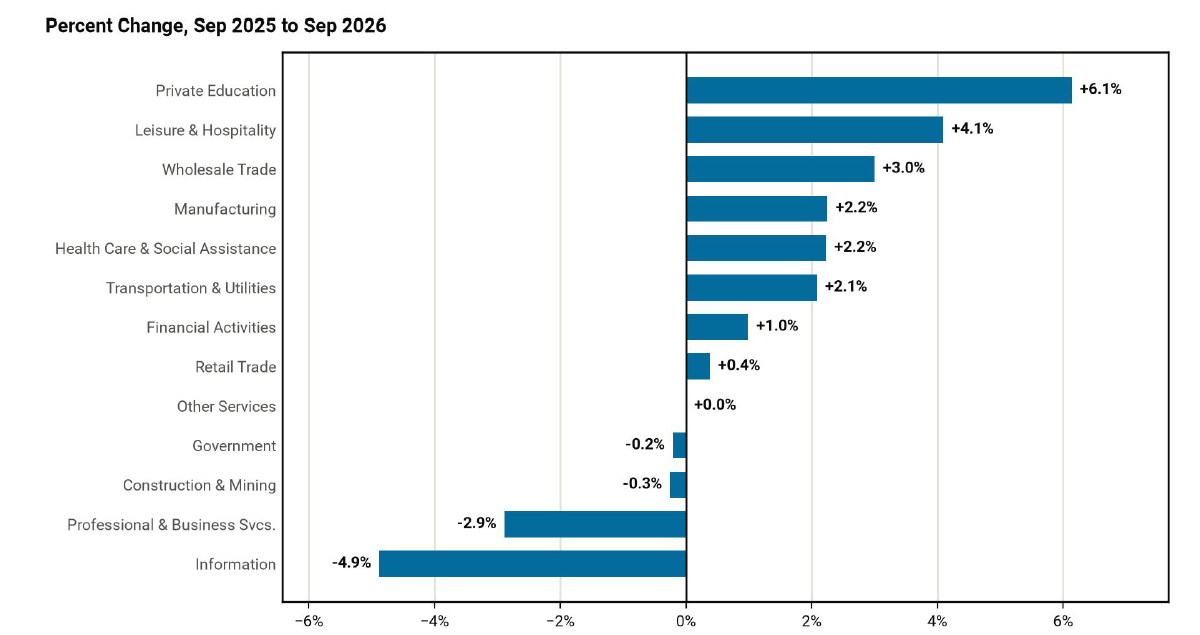
Source: U.S. Bureau of Labor Statistics, Current Employment Statistics, via Haver Analytics. Not seasonally adjusted. Published survey data, not early benchmarked.
Similarly, Gustavo Rojas-Matute of Moody’s Analytics noted that the Island’s Economic Activity Index has been moving sideways and remains below levels observed in previous years.
Leslie Adames, Director of Economic Analysis and Policy at Estudios Técnicos, offered a similarly cautious outlook. His baseline forecast projects a 1.4% contraction in real Gross National Product (GNP) in 2027, reflecting weak growth across most economic indicators. Of the 17 indicators monitored by Estudios Técnicos, only two currently show improvement compared to 2025: private employment and business applications.
“The Puerto Rico Planning Board tells us Puerto Rico’s economy will not grow this year or the next, and I must concur with this projection,” Adames indicated.
Demographics Remain a Defining Challenge
One issue generated broad agreement among participants: Puerto Rico’s demographic reality.
Population decline and aging continue to affect labor force participation, economic dynamism, and long-term fiscal sustainability. Scally highlighted the continued outmigration of young adults, noting that roughly one-third of this population left the Island.
“The picture today is stable,” Scally explained, “but there are some tougher questions about the medium and longer term with the population decline.” A shrinking and aging population, she noted, can ultimately reduce the labor force, shrink the tax base, and weaken the economic activity that drives growth.
Economists also noted that while labor force participation has improved in recent years, it remains well below U.S. levels, limiting the size of the workforce available to support long-term growth.
Both Adames and Indira Luciano Montalvo, Associate Professor of Economics at the University of Puerto Rico, emphasized the importance of strengthening the economy’s productive capacity.
“Fiscal sustainability should be built on a stronger productive economy, not solely on tax incentives or short-term revenue measures,” Luciano Montalvo stated.
Investment Creates Opportunities, But Structural Issues Persist
Despite the slower outlook, Puerto Rico continues to benefit from important sources of investment.
According to Rojas-Matute, more than $2 billion in pharmaceutical and medical-device investments have been announced since 2025, including major commitments from companies such as Lilly and Amgen. Tourism has also remained a bright spot. Visitor arrivals remain well above pre-pandemic levels, hotel demand continues to grow, and cruise passenger activity has expanded significantly, supporting employment and business activity across the sector.
At the national level, Ben Herzon of S&P Global Market Intelligence noted that artificial intelligence investment remains a significant driver of economic growth in the United States. Business investment has accelerated substantially since late 2024, largely because of AI-related spending.
Yet some panelists warned that investment alone is not enough.
Luciano Montalvo argued that attracting capital should not be confused with building productive capacity. She emphasized the importance of industrial policies grounded in evidence, sector analysis, and strong local economic linkages that generate lasting economic value.
Her recommendations included identifying industries that can create ripple effects across Puerto Rico’s economy by supporting other businesses, creating jobs, and generating broader economic activity, while also rebuilding the critical infrastructure needed to support growth.
Reconstruction spending also remains an important source of economic activity. According to Adames, roughly $41.7 billion in reconstruction funds remain undisbursed, creating the potential for sustained investment in infrastructure over the coming years. However, economists noted that permitting challenges, labor shortages, construction costs, and execution capacity will ultimately determine how much of that funding translates into economic growth.
Costs Are Increasing Pressure on Households and Businesses
Another area of broad concern was the cost environment facing residents and employers.
Xavier Diví of V2A Consulting pointed to inflation, elevated electricity prices, and slowing consumption as important headwinds. “Given the geopolitical situation, it is predicted that profit margins for the business sector in Puerto Rico will remain under pressure, as will cost projections,” he explained.
According to Diví, average commercial electricity prices are approximately 31% higher than pre-pandemic levels, and residential prices are about 21% higher, squeezing business profit margins and complicating growth prospects for many sectors.
Beyond stagnation, inflation and power costs are squeezing household budgets and business margins

Consumer price inflation, year-over-year (%)
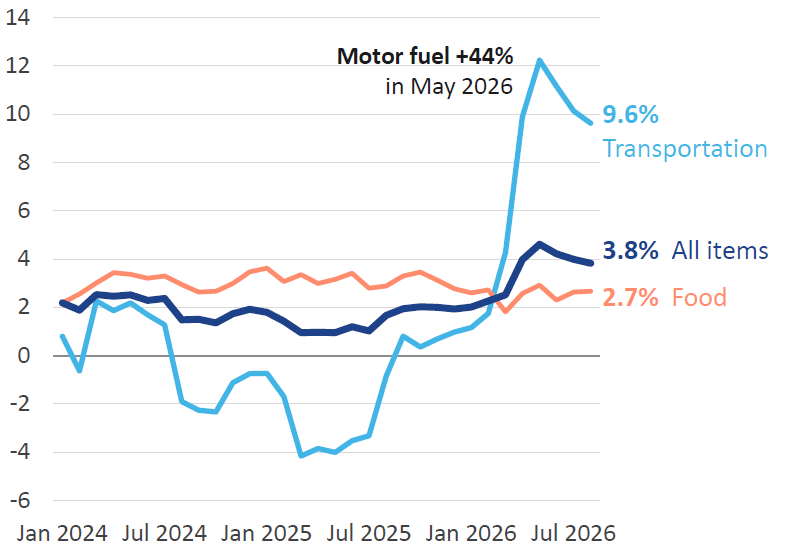
Source: PR Department of Labor (DTRH) CPI, latest Aug 2026
Average electricity price, Puerto Rico (¢/kWh)
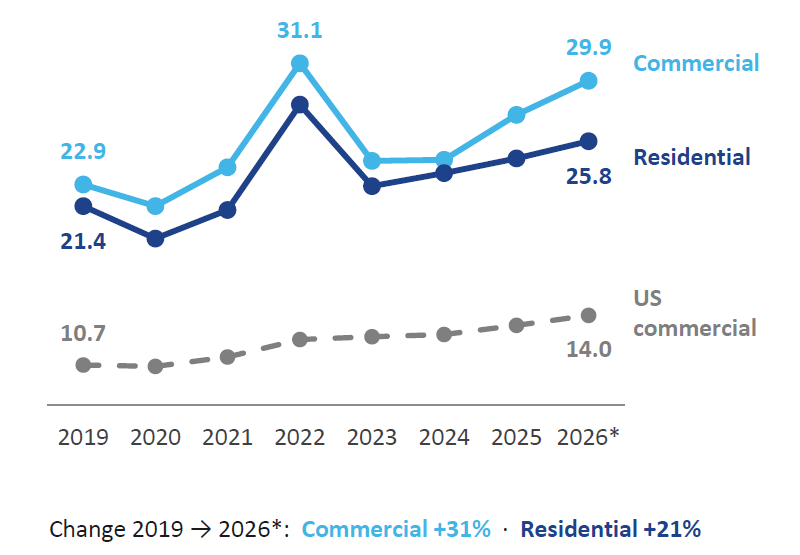
Source: EIA; *2026 = Jan-Aug average, preliminary
A 20% rise in power prices costs Puerto Rico ~$935M a year; it cuts in halve a typical supermarket’s net margin
Rojas-Matute similarly noted that high oil prices, elevated borrowing costs, and record electricity rates continue to offset many positive developments occurring elsewhere in Puerto Rico’s economy.
At the U.S. level, Herzon highlighted ongoing inflationary pressures linked to global energy markets. “Inventories of crude oil are tight,” he noted. “As long as they remain tight, there will likely be a premium in crude oil prices.”
At the same time, several indicators suggest households remain relatively resilient. Diví noted that bank deposits remain significantly above pre-pandemic levels and loan delinquency rates remain near historic lows. However, he cautioned that the durability of those financial cushions will depend on whether income growth can keep pace with rising costs.
Policy Choices Will Shape the Long-Term Outlook
While the panelists identified numerous challenges, they also pointed toward policy areas that could improve Puerto Rico’s growth potential.
Recommendations included accelerating federally funded infrastructure projects, modernizing the electric grid, improving permitting processes, simplifying the tax system, investing in climate resilience, expanding workforce development and reskilling efforts, and adopting industrial strategies that strengthen local supply chains and productive capacity.
Economists also emphasized preparing for known fiscal risks. These include the gradual decline of federal reconstruction spending that has supported economic activity in recent years and the expiration of enhanced Medicaid funding.
“The temporary extension of the Medicaid match… which was raised up to 76%, is set to expire next year and it’s going to return to 55%, so the Government of Puerto Rico does not have, at this moment, the funds to cover that gap,” explained Rojas-Matute. “We are expecting a slight decline in the healthcare sector, because there will be less funds.”
The message from the symposium was clear: Puerto Rico is not facing an economic crisis, but neither is it experiencing the kind of sustained growth needed to overcome its long-standing structural challenges.
The Island’s future will depend less on short-term fluctuations and more on whether policymakers can successfully address productivity, demographics, workforce participation and skills, infrastructure execution, energy costs, and overall competitiveness. As federal support gradually fades and demographic pressures intensify, those decisions will play an increasingly important role in determining Puerto Rico’s economic path in the years ahead.